Monday, June 11, 2012

Apartment Therapy says red seating is "IN"


We think red is always a popular color. But Apartment Therapy says that red is even more "in" right now, especially when it comes to seating.

The color red is meant for inciting, don't you think? It's almost like it was put on this planet to grab attention, raise the heart rate and make a piece of furniture pop like no other color. It's available in such a large gamut of hues there's bound to be a red that fits your personality, and we know just what sort of furniture piece to use as a vehicle for this bold color.


Seating: It's something many rooms require and many more benefit from, and if you have been wondering what type of furniture piece you should choose to bring a pop of red in a space, we humbly submit seating as an option. From benches, to chairs, to sofas and more, a red seat in a room is a bright and bold beacon beckoning guests (and yourself) to take a load off.


In the center of a room in a seating arrangement, a red chair will tie a space together, and along the wall in a vignette the color red will keep a piece from becoming a wallflower. If you don't believe us, just check out the evidence found in recent Apartment Therapy house tours:


See more fabulous red decor at Apartment Therapy.

And here are a few of our top-selling, always popular red pieces (not just seating!)


How do you use red to decorate?

Friday, June 8, 2012

eHow's Rules for Table Lamps


Many people feel overwhelmed when it comes time to pick out table lamps. But there's no reason to. Picking lamps can be a lot of fun, especially if you've done your homework first! This guide from eHow tells you just what you need.

Imagine your home without table lamps. A gathering of friends would feel stark and impersonal rather than warm and convivial . There would be no place to curl up and read the latest best seller. Table lamps are part of what gives the home personality. Yet the average person knows very little about selecting and decorating with table lamps. These six key points should help.


Function
Table lamps are the most versatile types of household illumination. They can be easily moved from one location to another and are commonly used as accent, general and task lighting in the home.   
(Accent lighting is secondary light that provides points of visual interest in a room. General lighting supplies a comfortable level of illumination throughout a room. Task lighting is light focused on a particular activity.)


Style
Table lamps are functional, but also serve as decorative accessories in a room. Choice of lamp styles is strictly a matter of personal taste. It is not necessary match the style of table lamp to your room's particular decor, but do make an effort to coordinate the look. An early American lamp is obviously a poor choice for an ultra-modern room.


Proportion and Height
Scale is one of the main elements to consider when choosing the right table lamp. Your overall lamp size should be in proportion to the room's furnishings. The proper height for a table lamp is based on the height of your seating and table. The lower rim of the lampshade should be between shoulder and eye level of the person seated next to the table lamp.


Lamp Shade Tips
Lampshades for table lamps should never exceed the diameter of the table surface. It is wise to bring your lamp to the store to select the proper size in relation to the lamp base. If you are unsure of which shape shade to buy, simply mirror the shape of the shade to that of the lamp base. (At Home Decor, you don't need to worry about this one. All of our lamps come with proportional, matching shades!)


Number of Lamps
There is no set rule regarding the acceptable number of table lamps per room. It is recommended to  
use multiple table lamps in larger rooms to maintain even ambient light distribution. You should also 
place a table lamp on each table next to chairs, sofas and beds unless you are relying on another direct light source such as a floor lamp, wall lamp, track or recessed lights.


Hiding Lamp Cords
For those of us who enjoy table lamps, one big dilemma is how to conceal the lamp cords. For homes with open floor plans, this can be a particularly tricky issue. Martha Stewart recommends hiring an electrician to install floor outlets. Cords can also be run along baseboards in molded plastic channels and hidden under rugs in non-traffic areas. Another suggestion is to use decorative fabric covers to "dress up" unsightly bare cords.

Read more at ehow.com.

Wednesday, May 30, 2012

Modular Sectionals: Why are they a good investment?


There are many reasons to choose a modular sectional (such as the fact that ours is on sale this month!) but 2 of the most often cited reasons are versatility and saving space.

Versatility:


With large, joined couches, the size of a room is often the most important factor in the selection process. You might come across a couch that you absolutely adore only to discover that you can't buy it because its dimensions are all wrong. Sectional sofa couches eliminate this problem due to the fact that they can be manipulated to fit into any room, regardless of shape.


Most sectional couches can be configured into at least eight to ten different formations, from straight lines to l-shaped and horseshoe shaped configurations. Larger couches can even be placed in interesting octagonal or equiangular formations. Many people buy a couch to fit into one room in particular, and then find themselves in a complete bind when they move homes. Sectional couches can be separated and then reconfigured to suit a new space. If certain sections don't look right in their new space, you can always move them to different rooms around the house. A single arm chair or chaise can always be moved into a bedroom or TV room.


Space saving:


Sectional sofas are adaptable enough to fit into even the smallest of rooms. This is primarily due to the fact that sectional couches can be configured to take advantage of space that would normally go unused. Because they can be configured around other furniture as opposed to beside it, sectional couches offer the advantage of providing the maximum amount of seating in the smallest amount of space. By carefully configuring a sectional couch to fit into unused corners and crags, you can create additional space in the center of a small room and prevent it from looking crowded.

Read more: http://www.guide4home.com/dec-sofa/sectional-couch.htm

Friday, May 25, 2012

Bringing Furniture Into the Bathroom

Get the scoop on a hot new trend in the furniture world...furniture in the bathroom!


Don't worry. I am not going to torture you with photos of cavernous bathrooms that resemble formal parlors straight out of Downton Abbey. I think we all know those sumptuous Elle Decor and Architectural Digest bathrooms adorned with grandoise antique armoires, chaise lounges and massive armchairs. It's a wonder the homeowners don't entertain guests in their lavatories.


But mammoth pieces of furniture are no use to those of us with regular or small-sized bathrooms. Never fear. You, too, can incorporate interesting case pieces, chairs and tables into your bathroom. Integrating furniture not normally associated with the bathroom (from little night stands to wicker chairs to vintage medicine cabinets) is a lovely way to soften a bathroom's harshness while adding storage and character.


Here are some of our favorites:


Ready to redecorate your bathroom? Here are some great pieces from Home Decor that you can use to freshen up your space!


Friday, May 18, 2012

Practical, Inexpensive Gifts for High School Graduates


Great gift ideas for recent high school graduates!

Graduating from high school is a major milestone, celebrated with an open house and lavishing of gifts. Most graduating high school seniors will soon be going out into the world, however few are completely prepared. For these young adults, household necessities are gifts that they will appreciate for years to come. Many of these items are inexpensive as well, making these type of items a graduation gift tailored to any budget.


Bath Linens


When I graduated high school over ten years ago, one of the best gifts I received was a plush, oversized bath towel. It was from my cousin, who personalized it by having my name embroidered in large letters across the bottom. It has long been my favorite towel. I still have the towel, which has outlasted many other towels and remains in good condition, a testament to its quality. Towels, wash cloths, and bath rugs are all items a grad will soon need.


Kitchen Wares


Life on your own means preparing your own meals. Basic kitchen implements from wooden spoons to microwave ovens are things a graduate will need but likely doesn't have. Other inexpensive ideas include crock pots, coffee makers, cookware, and cookie sheets.


Serving Ware


Along with pots and pans, a basic set of serving ware is a thoughtful gift. A small set of plates and silverware are items a grad is sure to use. A set of drinking glasses is also a useful gift.


Compact Furniture


Whether moving into the dorms or into an apartment, grads will appreciate compact pieces of furniture. Items like fold-up tray tables are practical and functional, and take up very little space. Comfortable camping chairs take up very little space in a closet or dorm room, providing extra seating for guests or even used in lieu of larger, more expensive pieces of furniture that aren't within a college student's budget.


Gift Cards


Aren't sure what the grads you know need? Gift cards are always an appropriate gift choice. Stores that sell groceries, cleaning supplies, house wares, and other things a young adult needs to purchase on their own are good places to buy gift cards. For grads who will be commuting to college, a gas card is a gift they will be thankful for. If you are buying for a grad who lives out of town, make sure that you purchase a card for a store that has locations in their area.


Read more: http://voices.yahoo.com/practical-inexpensive-gifts-high-5838620.html?cat=7

Friday, May 11, 2012

Glossary of Bedroom Furniture Terms


Shopping for furniture can be confusing if you don’t know the lingo! Here’s a quick crash course in some of the most commonly used bedroom furniture terms.


Rails – Long metal bars that attach a headboard and a footboard. Rails can have metal hooks at each end (hook-on rails) or flat panels with screws at each end (bolt-on rails).


Metal bed frame – A simple, non-decorative bed frame made entirely of metal. You can always tell the difference between metal frames and metal rails by seeing where the support comes from. If you see little metal feet going from the frame to the floor, you know you’ve got a frame. If there are no feet, you’ve got a pair of rails (for rails, the support comes from the headboard and footboard).


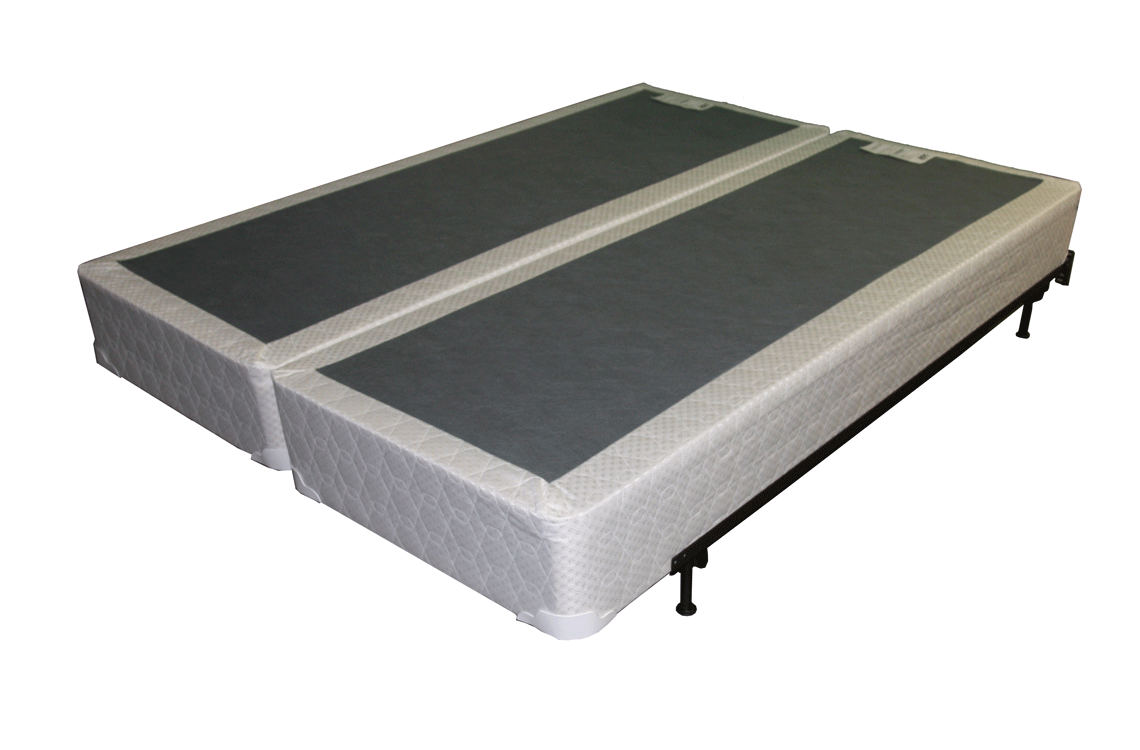
Split Box Spring – 2 smaller-sized box springs that can support a larger sized mattress when placed side by side. Split box springs are much easier to move around than regular box springs. Also, doorways and stairways in some cities are smaller than average, and split box springs are much more likely to fit through.


Headboard – A piece of furniture that attaches to the head of a bed.

Baseboard or Footboard – A piece of furniture that attaches to the foot of a bed.

Slats – Flat pieces of wood that lay inside a bed frame to provide additional support to a mattress. Slats can be screwed in place or just lay freely depending on the bed.


Bunkie board – A flat piece of wood shaped, fitted, and often covered in fabric to lay in a bunk bed as support for a mattress. Many bunk beds have slats (see above) that are very far apart, so a Bunkie board is critical to keep a mattress from sagging through.

Bunkie mattress – A mattress with a wooden frame built into the underside. It serves the same purpose as a Bunkie board, but there’s no need to shop for a separate mattress since it’s built right in!

Need clarification on something else? Ask us in the comments!

Friday, May 4, 2012

The Carpet Myth...Debunked!

We’ve all probably heard that carpets and rugs are bad for people with allergies. The good news is that it may not even be true. Bring on the throw rugs!

A simple Google search will direct you to numerous sites that attribute allergy irritation to carpet and suggest that a switch to hard flooring surfaces such as laminate, hardwood, or vinyl will solve your problems. The real problem is that many of these sites are authored by individuals outside of the flooring industry who postulate without testing. On the contrary, carpet studies preformed by the Carpet and Rug Institute have indicated that carpet is the best flooring choice for allergy sufferers because it is better at trapping allergens than hard surfaces. Once allergens are trapped in the carpet, they cannot circulate in the air you breathe.


Proper cleaning with a CRI tested and approved vacuum effectively sucks up the dirt and dust from the carpet, locks it in the machine, and keeps it out of the air. In addition, scientific studies now show that carpet is one of the lowest emitters of volatile organic compounds (VOCS) into the indoor environment. Carpet has recently been proven to emit less VOCS than other flooring products and wall paint.


Twitter Delicious Facebook Digg Stumbleupon Favorites More